Stage 1
 Stage 1
Extraction & Purification of Oils
This stage is explained, not instructed — the concept and the hazards, with the method left as history. The page tells you why.
What extraction actually is
Seb
Extraction means washing cannabis with a solvent that dissolves its resin — the cannabinoids and terpenes — so the oil leaves the plant behind and stays in the liquid, then driving the solvent off to leave a concentrated oil. The principle that makes it work is “like dissolves like”: non-polar resin dissolves into a non-polar solvent. The one thing that makes it dangerous is the solvents that dissolve resin best are also the ones that catch fire easiest, and it’s the vapour, not the oil, that’s the hazard.
Extraction is the oldest idea on this shelf, and the simplest to state: get the oil out of the plant and leave the plant behind. The resin a cannabis flower makes — the cannabinoids, the terpenes — is largely non-polar. So is a class of solvents. “Like dissolves like” does the rest: wash the plant material with the right solvent and the resin lets go of the flower and dissolves into the liquid. Drive the solvent off afterwards and you’re left with a concentrated oil.
Purification is the same principle run again to clean the result — using differences in solubility to separate the oil you want from the waxes, chlorophyll and plant debris you don’t. (The full foundations — polarity, “like dissolves like,” separation — are laid out in the Isomerization theory module; this page assumes them.)
That’s the concept. It’s genuinely elegant chemistry, and it’s also where the danger starts — because the solvents that dissolve resin best are, almost without exception, the ones that catch fire easiest.
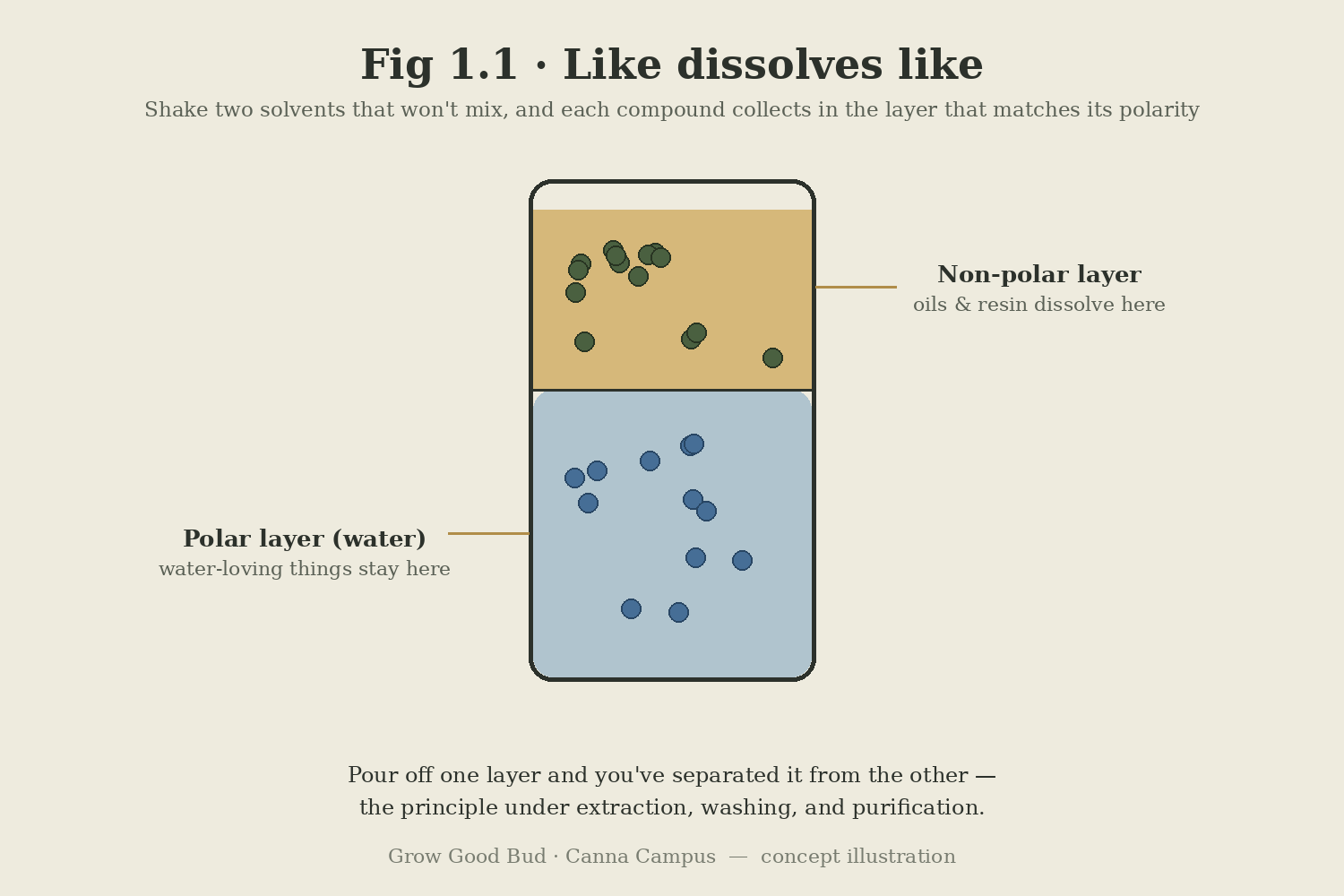 Fig 1.1 — “like dissolves like.” Non-polar resin gathers in the non-polar layer, water-loving compounds stay in the water; pour off one layer and you’ve separated it from the other. The principle under extraction, washing, and purification.
Why I’ll teach the idea but not the method
Dave
Extraction is the one chapter people assume is harmless, because it feels like making a strong cup of tea. It isn’t. The whole job hinges on volatile solvents, and that’s the part I won’t write a recipe for.
It’s not the oil that’s the hazard — it’s the vapour. Get into the specifics of which solvent, how much, and how you drive it off, and I’d be writing the exact conditions under which a room fills with something that’s just waiting for a spark. I’m not doing that, same as I won’t for any stage on this shelf that runs on solvents or acids. The concept is yours. The conditions stay history.
If you want the genuinely safe version of “getting something out of a plant,” that’s mechanical separation — and it’s the next teachable chapter, Hashish, which uses no solvents at all.
Hazards — the bit to remember
Dave
This is how people actually get hurt with extraction, told plainly so it sticks. None of it is how-to.
The vapour, not the liquid, is the bomb. Solvent fumes are heavier than air. They pour off the container, pool low, and travel along the floor until they find an ignition source — a fridge compressor kicking in, a light switch, a pilot light in the next room. The fire starts where the vapour got to, not where you’re standing. People who “kept it away from flames” still got caught, because they were guarding the wrong patch of air.
Indoors is the trap. Most serious extraction accidents happen in kitchens, sheds and bathrooms — enclosed spaces where vapour builds instead of clearing. The “I cracked a window” instinct is nowhere near enough.
Static and electronics count as sparks. You don’t need a naked flame. A switch, a phone, a bit of static off a jumper — any of them is enough once vapour is pooling.
That’s the honest catalogue. Every one of those is a real way real people have lost eyebrows, rooms, and worse.
The real apparatus
Dave
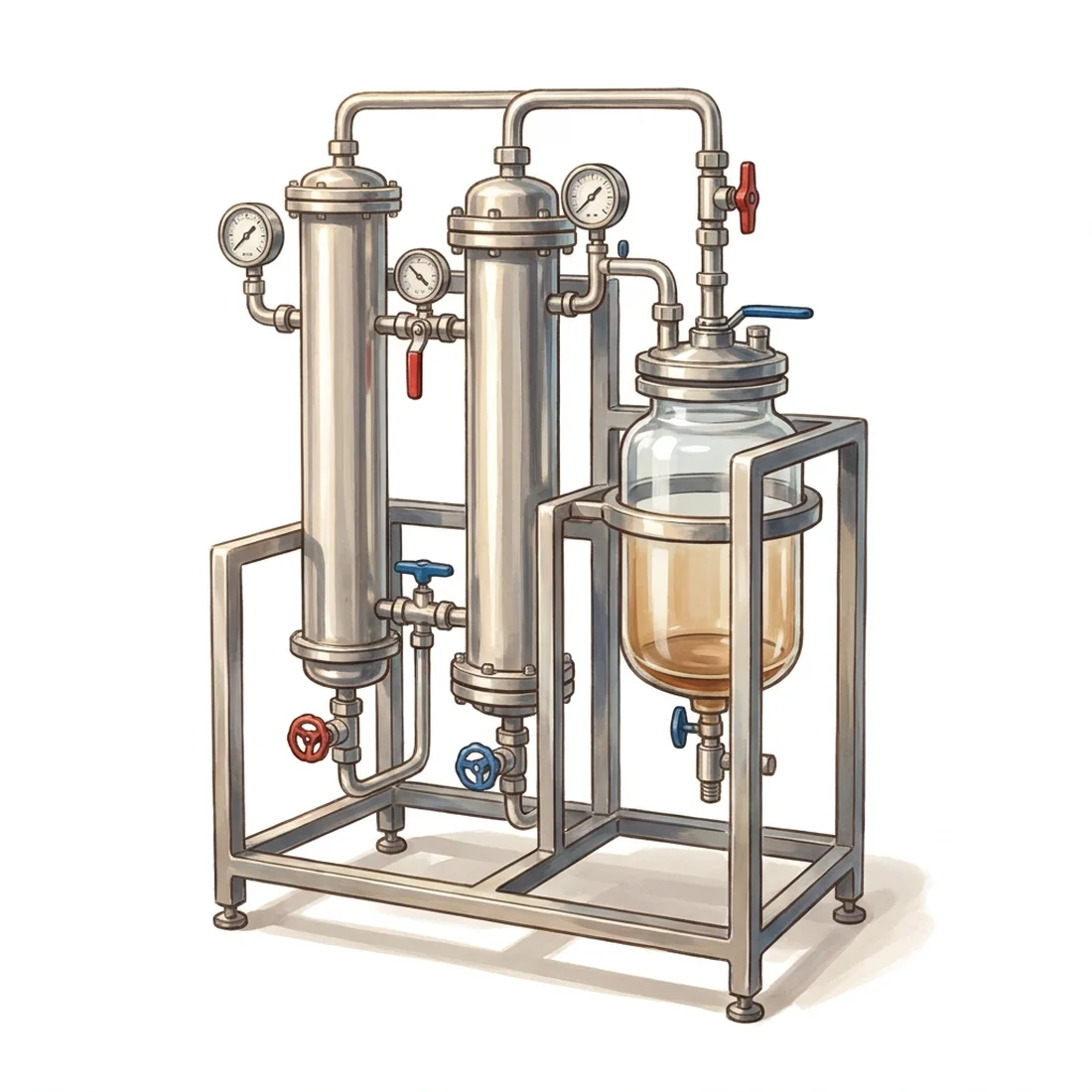 Reference only — a professional closed-loop extraction system: sealed stainless columns, rated valves and solvent recovery. Not a pot and a flame.
That’s what doing it properly actually looks like — sealed kit, recovery, a room built for it. The point of the picture is so nobody mistakes this for a job you do next to the kettle.
Where this leads
Seb
The chemistry under this chapter — solubility, polarity, separation, distillation — is the backbone of analytical and process chemistry, and of the legal extraction industry, where exactly this work is done in purpose-built rooms with explosion-rated equipment and trained operators. The curiosity is the start of a real trade. The free organic-chemistry routes in the Isomerization module are the honest way in.
Check yourself
- In one line, what does extraction do, and what principle makes it work? (Dissolves the plant’s resin into a solvent and leaves the plant behind; “like dissolves like” — non-polar resin into a non-polar solvent.)
- Why is extraction treated as a serious hazard despite sounding simple? (It depends on volatile solvents whose vapour is highly flammable.)
- Where does a solvent-vapour fire actually start, and why does that catch people out? (Wherever the heavier-than-air vapour has pooled or travelled — often away from the person, who was watching the wrong spot.)
- What’s the genuinely safe alternative for getting concentrate from a plant? (Mechanical separation — e.g. hashish — which uses no solvents.)
