Stage 2
 Stage 2
Isomerization
This stage is explained, not instructed — the concept and the hazards, with the method left as history. The page tells you why.
The framing
Dean of Dank
Isomerization rearranges a cannabinoid molecule into a different form of itself — the same atoms in the same count, arranged differently — under a strong acid and sustained heat held inside a volatile solvent. No atoms are gained or lost; one shape is coaxed into another, more stable one. The thing to understand is that this is a catalysed laboratory reaction, not an extension of growing or curing, and the acid that does the rearranging is corrosive enough to cause severe burns while the solvent over heat is a serious fire and fume hazard — which is why this course teaches the concept but not the method.
Alchemy gets laughed at now — the medieval fools who thought they could turn lead into gold. Strip away the mysticism, though, and what those men were chasing was transformation: the idea that one substance could be coaxed into becoming another, more finished version of itself. They never managed it with lead. The irony of history is that the principle was sound — they were simply working the wrong material with the wrong tools.
Isomerization is the chapter where that old dream brushes up against real chemistry. The plant hands you one arrangement of atoms; under acid and heat, that arrangement can shift into another. Same atoms, rearranged — not lead into gold, but a molecule into a different form of itself. The alchemists would have understood the ambition perfectly.
And here is where the romance ends and the respect begins. The force that does the rearranging is corrosive enough to rearrange you, and the conditions it demands have sent careful people to hospital. Which is why, on this course, this chapter is told and not taught — why it sits behind a lock and finishes in a lecture hall rather than a recipe. Understand the history. Respect the chemistry. Leave the practice to the people with the fume hoods.
Sempre Avante.
What isomerization actually means
Seb
Isomer. Two molecules built from the exact same atoms, in the exact same count, arranged differently. Same bricks, different model. Δ9-THC and its near relatives are that — one formula, more than one shape.
Isomerization is the act of coaxing one of those shapes into another. In the older processing literature it was valued for two things: settling the restless Δ9 form into a more stable arrangement, and converting a share of the plant’s cannabidiol (CBD) toward THC. The appeal, historically, was a steadier, more uniform finished oil.
Here’s the part that matters for this course. That coaxing is a catalysed chemical reaction. It requires a strong acid and sustained heat held inside a volatile solvent. That is laboratory chemistry — a controlled reaction, run with proper equipment, by people trained to run it. It is not an extension of growing, and the gap between it and curing isn’t a matter of degree. Curing finishes a plant you grew. This re-engineers a molecule.
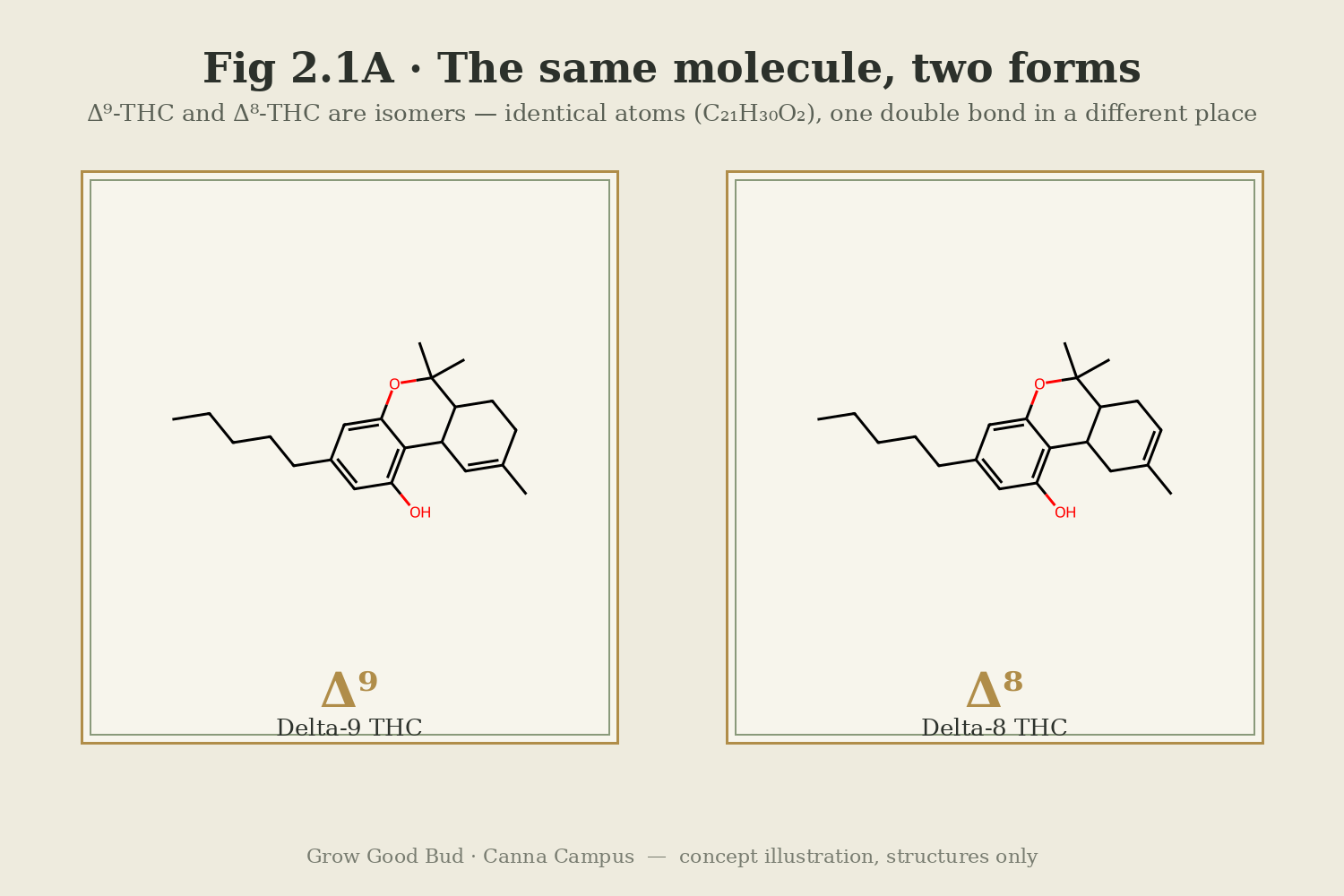 Fig 2.1A — the same molecule, two forms. Δ⁹ and Δ⁸ are isomers: identical atoms, one double bond in a different place. Structures only — no apparatus or process.
Why I’ll teach the idea but not the method
Dave
Everywhere else on this site I hand you the actual steps. This one I don’t, and you deserve the reason straight rather than a locked door with nothing behind it.
Two reasons, both real. The first is that the hazard isn’t theoretical. The reagent at the centre of this is the kind of acid that takes skin off on contact and doesn’t wait for you to notice — and the procedure asks you to use it next to a volatile solvent over heat, which is its own fire-and-fume problem. That combination has hurt careful people and badly hurt careless ones. It belongs to trained lab work with real ventilation and protection, not to someone improvising at a bench. I’m not going to write the words that make improvising feel safe, because they wouldn’t be true, and a confident-sounding shortcut is exactly how people get burned.
The second is the line itself. Growing your own plant and curing it is one thing. Chemically converting and concentrating a controlled compound to make it stronger is a different thing — in plain fact and in the eyes of the law. I’ll teach you what the stage is, so you understand the history of your own craft. I won’t write you the manual for doing it.
So take this page as exactly that: the theory, and the respect. The original 1973 text is in the public archive if you want the museum piece. What I can give you honestly is the understanding of what this stage is — not the recipe for running it.
Chemistry foundations — for anyone who wants to go further
Seb
Up front: this section teaches the general principles, the ones that run through all of chemistry — not the specifics of running this reaction. If it lights a spark, the next step is a real organic chemistry course, not this page.
Polarity, and “like dissolves like.” Every solvent sits somewhere on a scale from polar to non-polar. A polar molecule — water is the classic — carries an uneven charge: one end slightly positive, the other slightly negative. A non-polar molecule — oils, fats, many plant resins — spreads its charge evenly. From that one fact falls a rule that runs through the whole subject: like dissolves like. A polar solvent dissolves polar things; a non-polar solvent dissolves non-polar things. Oil and water won’t mix because one is non-polar and one is polar, and neither can get a grip on the other.
Why polarity lets you separate things. Because like dissolves like, you can put two solvents that won’t mix into the same vessel — a watery polar layer and an oily non-polar layer — and let every compound choose its side. Shake them, let them settle into two layers, and each compound collects mostly in whichever layer matches its own polarity. Pour off one layer and you’ve separated it from the other. That single idea sits behind an enormous amount of purification: decaffeinating coffee, lifting fragrance oils out of plants, cleaning up a mixture on a lab bench. It isn’t specific to anything here — it’s one of the first tools any chemist is handed.
What a catalyst is. A catalyst speeds up a reaction without being consumed by it. It lowers the energy hurdle the reaction has to clear, so the same change happens faster, or at a gentler temperature. When it’s done, the catalyst is still there — it made the introduction and stepped back.
What “isomerization” is at the molecular level. An isomer is the same atoms arranged differently. Isomerization is the conversion between those arrangements. It generally needs an energy input — heat — and often a catalyst to make the rearrangement happen at a useful rate. No atoms are gained or lost; their connections shift into a different, often more stable, configuration.
Where this goes, if you want it. That list — polarity, solubility, equilibrium, catalysis, reaction mechanisms — is gen-chem and the front door of organic chemistry. A first-year university organic chemistry course, or a solid free one like MIT OpenCourseWare’s, carries you from these ideas into how and why particular reactions actually proceed. That’s the honest route to understanding this chemistry: earned properly, in a place with a fume hood and someone watching your back.
What this page won’t do is map those principles onto this particular reaction — which solvent, which catalyst, which conditions, in what order. That mapping is the method, and the method is the part that stays behind the glass. The principles are yours to keep. The recipe stays history.
Hazards — the bit I actually want you to remember
Dave
I’ve made my case for not handing you the method, and I’m holding it. But I’m not naive. Some of you will go looking regardless, and I’d rather you went in scared of the right things than confident about the wrong ones. So here’s the danger, told plainly enough to stick. None of this is how-to. All of it is how people get hurt.
The acid is the one that gets you, and it’s a sneak. Strong acid doesn’t hurt the instant it lands — there’s a delay. So the classic injury isn’t a dramatic splash; it’s a speck on the back of your hand you don’t feel, so you carry on working, and by the time it stings it’s already through the skin. Eyes are the nightmare — a single airborne droplet will do it. If you take one thing from this entire page: eye protection isn’t the cautious option, it’s the only option, and gloves are not an “if I remember.” The late-arriving pain is exactly why people get badly hurt. They trust the silence.
The solvent doesn’t burn. The air above it does. Solvent vapour is heavier than air. It doesn’t politely rise and leave — it spills off the vessel, pools along the bench, and rolls until it finds a reason to light: a spark off a wall switch, a hot element, a pilot light clear across the room. Then the fire isn’t where your liquid is. It’s wherever the vapour got to. That’s why “I was careful with the flame” doesn’t save anyone — they were guarding the wrong patch of air.
You can’t smell your way to safe. The fumes off this kind of work aren’t a crack-the-window situation. Real ventilation, or don’t.
Never, ever alone. If the acid goes where it shouldn’t or the vapour finds a spark, the only thing standing between a scare and a tragedy is whether someone’s there to get you to water and dial for help. Solo is how a bad minute becomes the worst one.
And the jam jar will betray you. Improvised glass isn’t built for sustained heat. It cracks when you least want it to, and when it cracks it doesn’t just leak — it sprays, hot, with everything still in it. The “I’ll just use what’s in the kitchen” instinct is the one that ends in A&E.
That’s the honest catalogue. Not to walk you through anything — to make sure that if you ignore me, you at least flinch in the right places. Every one of those is a real way real people have been hurt, and not one of them announces itself in time. That’s the whole reason this stage lives behind the glass.
Check yourself — concept and safety only
- In your own words, what is an “isomer”? (Same atoms, same count, arranged into a different shape.)
- Why is isomerization described as laboratory chemistry rather than a growing or curing step? (It’s a catalysed reaction needing a strong acid and sustained heat in a volatile solvent — controlled lab work, not horticulture.)
- What makes this stage genuinely dangerous in general terms? (Concentrated acid causes severe burns on contact; a volatile solvent held over heat is a serious fire and fume hazard.)
- Why does this course teach the concept but not the procedure? (The hazard belongs to trained lab work, and chemically converting/concentrating a controlled compound is legally and practically distinct from growing and curing your own plant.)
- State the “like dissolves like” rule, and say why it lets you separate two compounds. (Polar solvents dissolve polar compounds and non-polar solvents dissolve non-polar ones; put two immiscible solvents together and each compound collects in the layer matching its polarity, so you can pour the layers apart.)
- Name two of the ways people are actually hurt at this stage. (Any two: delayed-action acid burns to skin or eyes; a flash fire from pooled solvent vapour finding an ignition source; fume inhalation; injury from improvised glassware cracking under heat; being alone when something goes wrong.)
The real apparatus
Dave
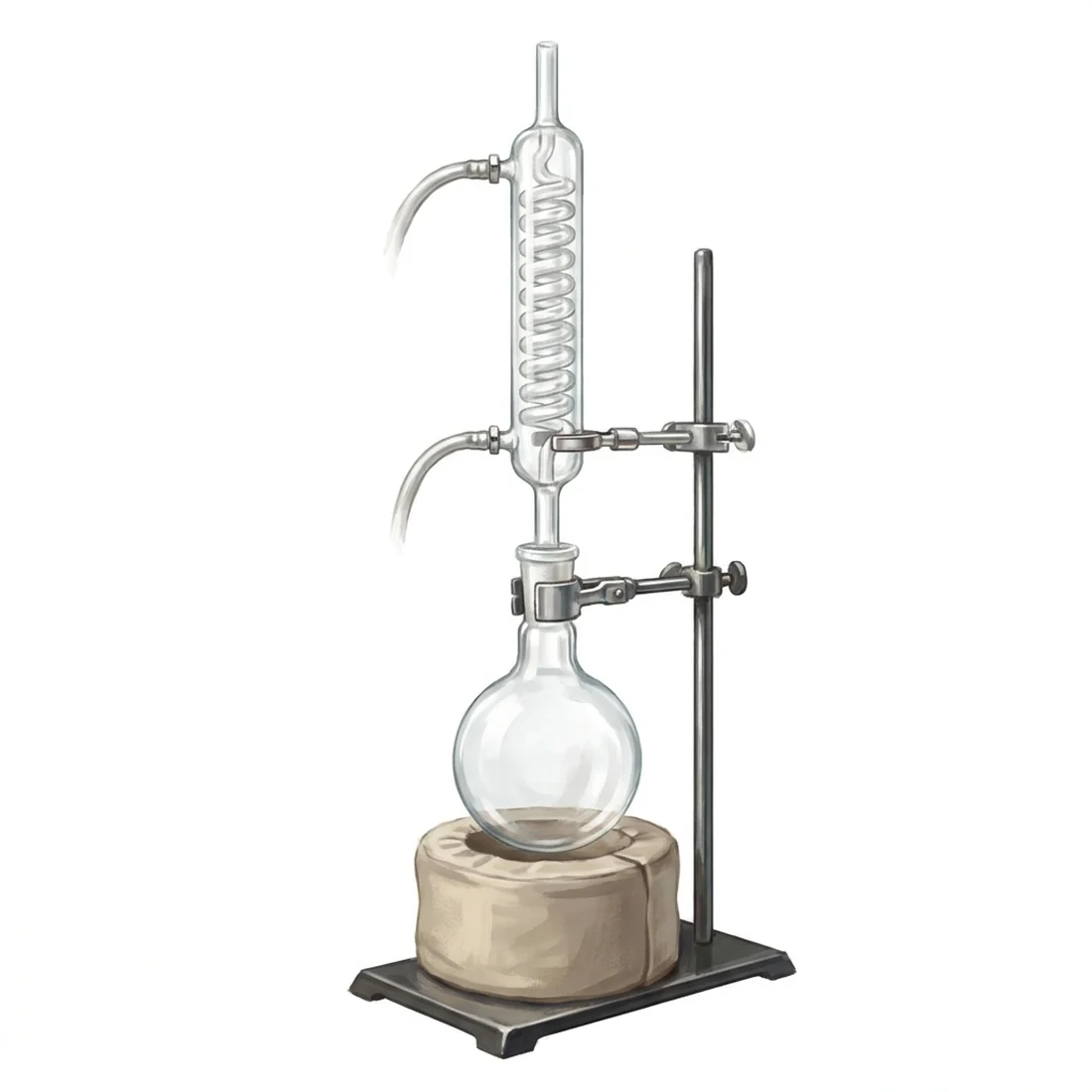 Reference only — a proper reflux rig: flask, condenser and controlled heat, run inside a fume hood. The glassware alone is specialist kit.
That’s what running this properly looks like — sealed glass, a fume hood, controlled heat. The point of the picture is so nobody mistakes it for something you improvise at the kitchen bench.
Where this can actually take you — study and career paths
Seb
Here’s the better ending, and the honest one. The curiosity that carried you to the bottom of this page — wanting to know what’s happening and why — is the same curiosity that builds a career. The only thing that changes is the room you do it in.
If you want to study it. Start with general chemistry, then organic chemistry — that’s where polarity, catalysis, and reaction mechanisms stop being trivia and start being tools. MIT OpenCourseWare and OpenStax both run the core courses free. From there, analytical chemistry is the science of proving what’s actually in a sample, and lab safety is its own proper discipline — the one that keeps the people in the next paragraph both employed and intact.
If you want it as a job. The legal, regulated cannabis and botanical-extract industry is real, and it runs on exactly these skills done properly: extraction technicians, analytical lab QA, formulation chemists, cultivation and plant scientists. The same foundations open doors well beyond cannabis too — pharmaceuticals, food science, fragrance and flavour, materials, environmental testing. Anywhere “like dissolves like” earns a wage. The work you just read about, someone does for a living. They do it with training, ventilation, regulation, and a payslip — the version where nobody loses an eyebrow or a court case.
The through-line. Everything this course taught you — reading a plant, respecting a process, knowing where your knowledge ends — is the same temperament a good lab is looking for. If a page about cannabis lit the fuse, follow it into a field that’ll pay you to be careful and curious at the same time. That’s not the consolation prize. That’s the upgrade.
And that’s the course. You came in quietly terrified of killing a seedling. You’re leaving able to read a plant, finish a harvest, and understand the chemistry well enough to know exactly why some of it belongs to people in lab coats. Take what’s useful, leave the rest, and mind yourself. Sempre Avante.
