Stage 3
 Stage 3
THC Acetate
This stage is explained, not instructed — the concept and the hazards, with the method left as history. The page tells you why.
What it is
Seb
THC acetate is made by reacting cannabis oil with an acetylating agent to bolt a new acetyl group onto the molecule — a synthesis step that produces a genuinely different compound from anything the plant makes, not just a rearranged one. The key reality is that it is the one technique this course actively talks you out of: it’s dangerous to produce, with the usual corrosive reagents and flammable vapour, and on current evidence dangerous to consume, since vaping it has been linked to serious lung injury — for a result that isn’t better, just different and less understood.
In the original book this chapter takes the oil and reacts it with an acetylating agent to make an acetate ester of THC — a chemically modified version of the molecule, not just a rearranged one. Where isomerization shuffles atoms that were already there, this bolts a new group on. It’s a synthesis step in the proper sense.
That distinction matters for one blunt reason: the result is a different compound from anything the plant makes, with a different and poorly understood safety profile.
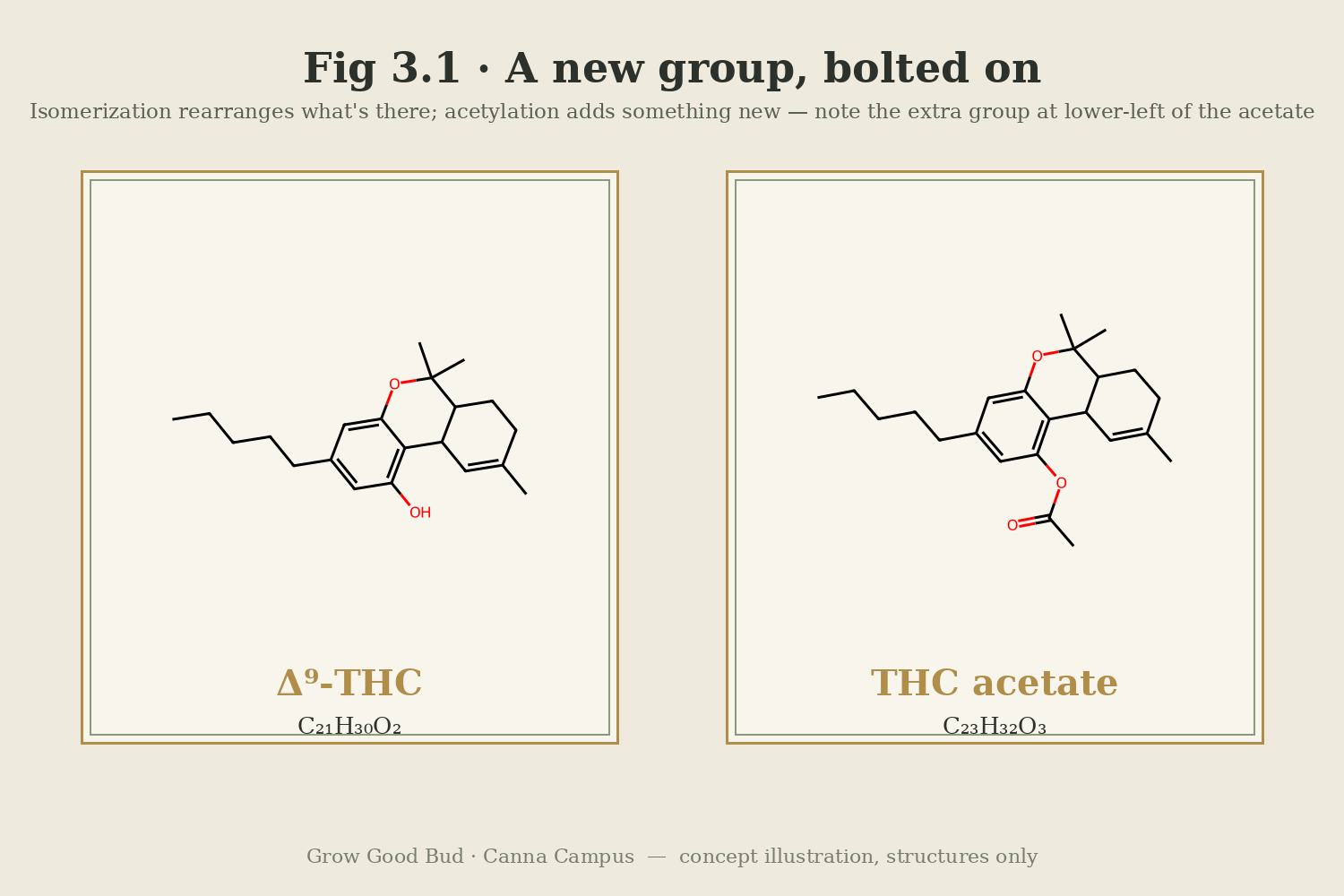 Fig 3.1 — where isomerization rearranges existing atoms, acetylation bolts a new group on: the THC hydroxyl (–OH) becomes an acetate ester, and the formula changes from C₂₁H₃₀O₂ to C₂₃H₃₂O₃. Structures only — no process.
Why this one gets a harder “no”
Dave
I’ve held back the method on every chemistry stage on this shelf. This is the only one where I’d go further and ask you not to chase it at all, and I’ll tell you why straight.
THC acetate — you’ll see it sold as “THC-O” — has been linked to serious lung injury when it’s vaped. The acetate group that makes it interesting on paper appears to be exactly the part that turns nasty when heated and inhaled, in the same family of problem that caused the vaping-injury scare a few years back. So this isn’t only the usual hazard of the chemistry that makes it — strong reagents, fumes, the lot. It’s that the thing you’d be making to use is, on current evidence, more dangerous to consume than what you started with.
That’s a rare combination: dangerous to produce and dangerous to use, for a result that isn’t better, just different and less understood. The honest teacher’s job here isn’t to gate it behind a quiz. It’s to say plainly: this is a dead end the history books wandered into, and the kind thing is to learn what it was and walk past it.
The hazards, in short
Dave
The making carries every danger of the acid and solvent work earlier on the shelf — corrosive reagents, flammable vapour, fumes you can’t smell your way clear of. And the product itself, heated and inhaled, has put people in hospital. There’s no version of this where the risk sits in a tidy box. That’s the catalogue, and it’s why this chapter ends here rather than in a method.
The real apparatus
Dave
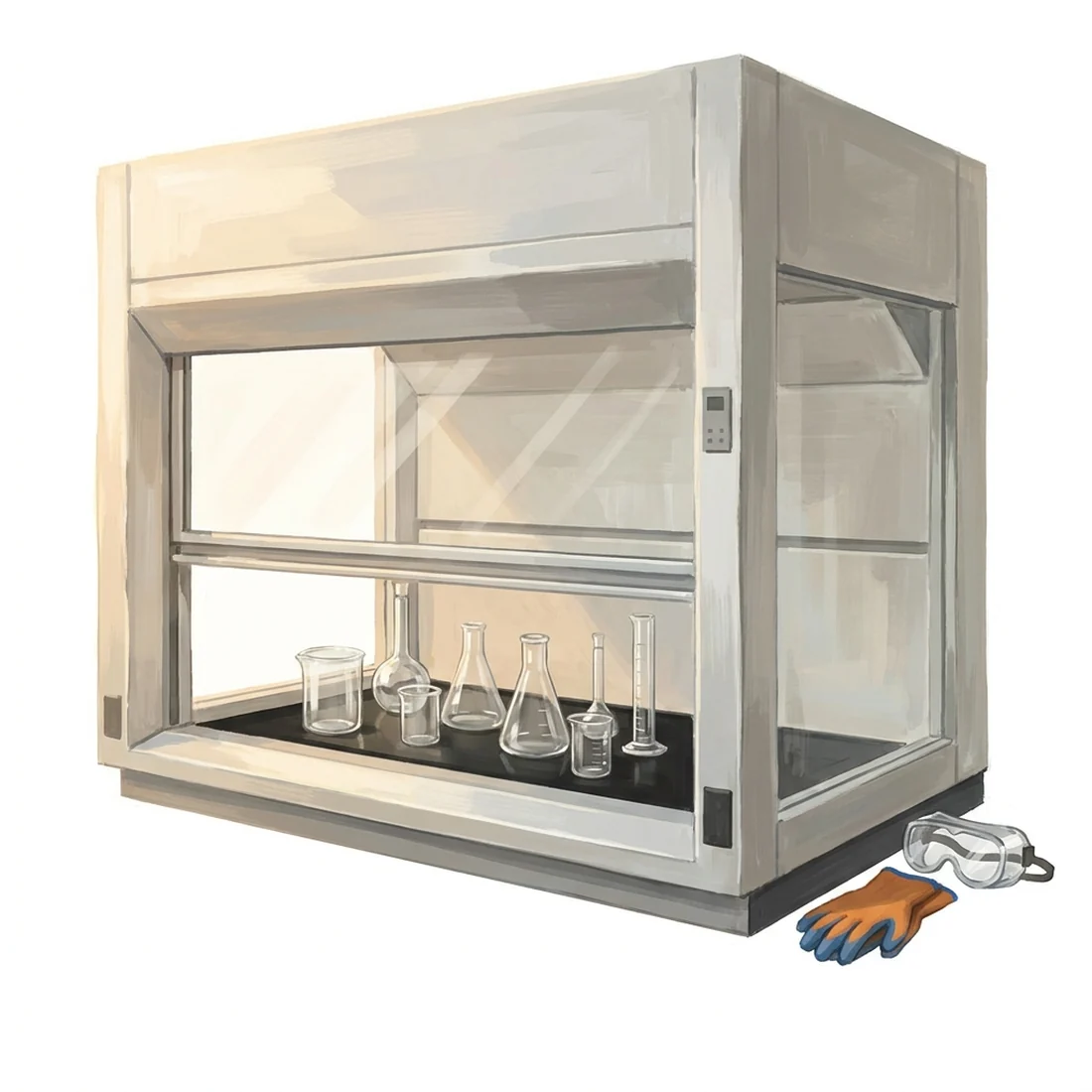 Reference only — a fume hood, lab glassware and real protective gear. If you don’t already have this room, that is your answer.
If the photo looks like a lab rather than a kitchen, that’s the whole point. The room is the warning.
Where the curiosity should go instead
Seb
If the chemistry of “modifying a molecule to change its properties” is what pulls you, that instinct is the whole of medicinal and synthetic organic chemistry — done in labs, with toxicology, regulation, and people whose job is to find out whether a new compound is safe before anyone inhales it. That’s the difference between a discipline and a dead end. The study routes are in the Isomerization module.
Check yourself
- How does acetylation differ from isomerization, chemically? (Isomerization rearranges existing atoms; acetylation bonds a new acetate group on — it’s a synthesis of a different compound.)
- Why is THC acetate treated as more dangerous than the earlier stages? (It’s dangerous to make AND, on current evidence, dangerous to consume — vaping it has been linked to serious lung injury.)
- What’s the honest takeaway this chapter is built around? (It’s a historical dead end; understand what it was and don’t pursue it.)
