Backcrossing and Stabilising a Cannabis Strain
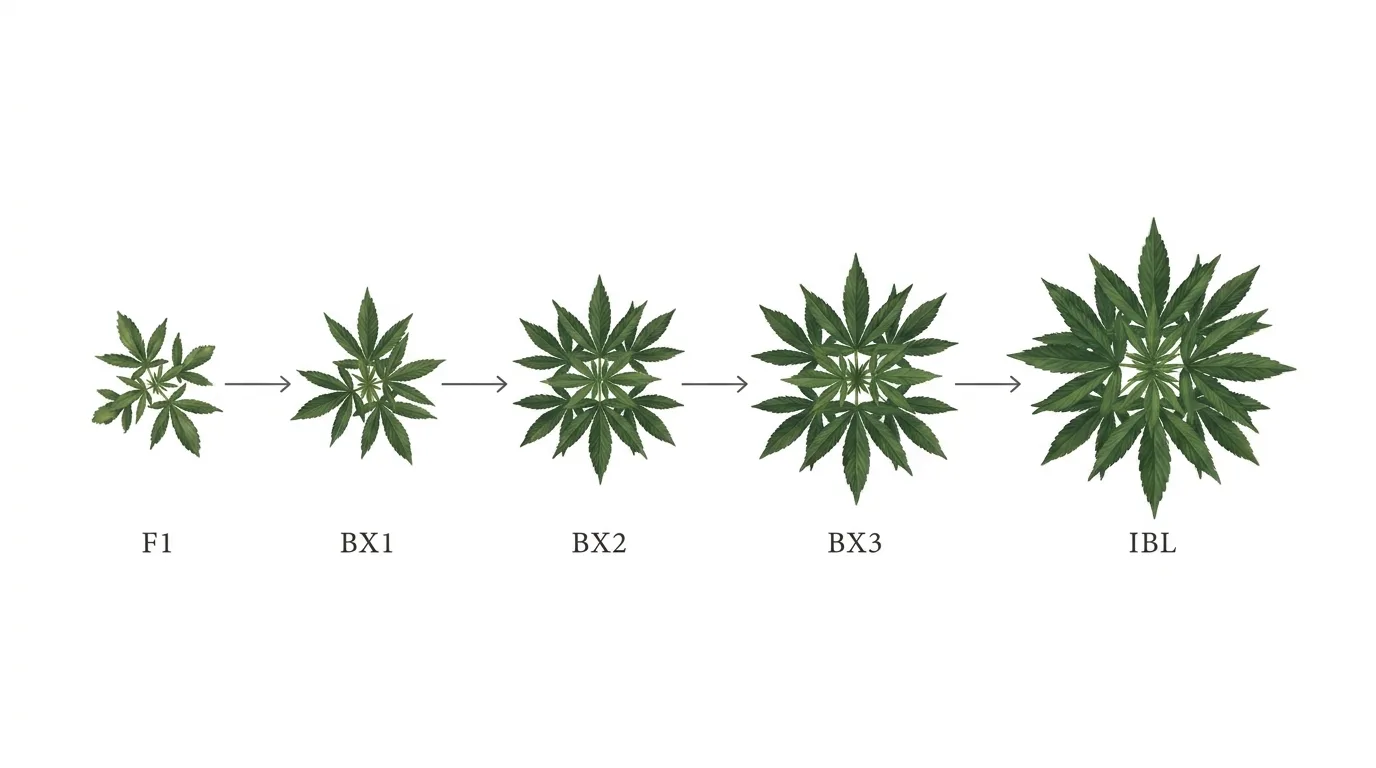
Short answer: backcrossing (BX) means crossing an offspring back to one of its parents to concentrate that parent’s genetics — F1 is ~50% of the target parent, BX1 ~75%, BX2 ~87.5%, and most programmes run BX3–BX5 to approach a stable, true-breeding inbred line (IBL).
That’s how a seed pack gives you ten near-identical plants instead of five random phenotypes. But too much inbreeding backfires: it causes inbreeding depression — weaker, lower-yielding, less resilient plants — so good breeders stop while the line is still healthy. So you’ve found a plant with a trait you love. Backcrossing is the technique breeders use to lock that trait in so the next generation reliably reproduces it instead of rolling the dice again. It’s the slow, real work of breeding, and knowing how it works tells you why a proper strain is so consistent.
The short version:
- Backcrossing (BX) = crossing an offspring back to one of its parents
- It concentrates that parent’s traits: F1 ~50%, BX1 ~75%, BX2 ~87.5%
- BX3–BX5 is common to approach a stable, true-breeding line (IBL)
- The endpoint, an IBL, gives near-identical plants from a seed pack
- Too much inbreeding backfires — inbreeding depression weakens the line
Want the full breakdown? Keep scrolling.
What is backcrossing?
It’s adding more of one ingredient to a recipe. Your F1 is a 50/50 mix of both parents; cross an F1 back to Parent A and the offspring (BX1) are roughly 75% Parent A; cross a BX1 back to Parent A again and you get a BX2 at about 87.5%. Each backcross concentrates more of the target parent’s genetics and reduces variation from the other parent. Breeders do this to lock in a specific thing — a terpene profile, a flowering time, a growth structure, a resin quality. If Parent A has a smell you want above all else, you backcross toward Parent A until that smell appears in nearly every plant, then test, cull and stabilise.
How many generations, and what’s an IBL?
There’s no single number, but BX3 to BX5 is common in commercial programmes — each generation narrows the variation further. The endpoint is an IBL (inbred line): a strain where ten seeds give ten plants that look and perform nearly the same, because the genetics have been homogenised through enough selection and inbreeding to breed true. That’s the work someone did before you ever opened your seed pack — years of selection you benefited from without seeing. The Impatient does one backcross, calls it stabilised, sells it, and his customers get five different phenotypes from a five-pack, because one backcross is a start, not a finish — he’s narrowed the chaos slightly and shipped the rest as a beta test.
What’s the catch with inbreeding?
There’s an honest tension: backcrossing concentrates traits, but too much inbreeding reduces genetic diversity. Every backcross doubles the chance that harmful recessive genes — harmless when hidden behind a dominant partner — pair up with no better version to fall back on. That’s inbreeding depression: weaker growth, lower yields, less stress resistance, more susceptibility to pests and disease. Good breeders know when to stop — they’re narrowing the window, not slamming it shut, keeping enough diversity for the line to stay healthy while being uniform enough to breed true. Balancing uniformity against vigour is one of the things separating a skilled breeder from someone with a paintbrush and a dream — and it’s why a well-bred stabilised line (the kind CSB carry) is worth more than a hyped one-off cross.
Common questions
What is backcrossing in cannabis breeding?
Crossing an offspring back to one of its parents to concentrate that parent's traits. It moves a line from ~50% of the target parent (F1) toward a stable, true-breeding inbred line over several generations.
What does IBL mean?
Inbred line — a strain stabilised enough that a seed pack produces near-identical plants. It's the endpoint of repeated selection and backcrossing, which is why bought strains are so consistent.
Can you over-backcross a strain?
Yes. Too much inbreeding causes inbreeding depression — weaker, lower-yielding, less resilient plants — as harmful recessive genes pair up. Skilled breeders stop while the line is still healthy.