Grow Room Extraction and Smell Control Explained
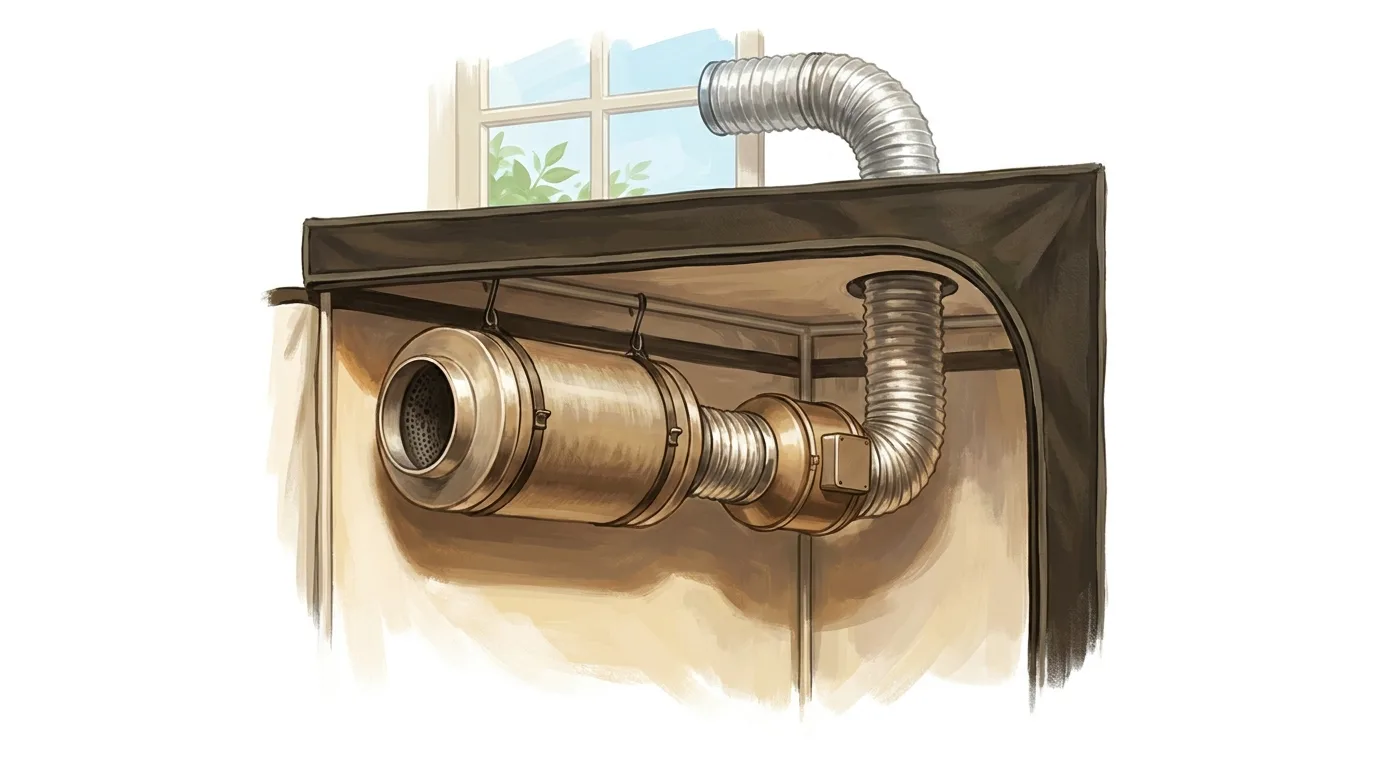
Size an extraction fan by tent volume in m³ × 60 for the minimum, then add 20–30% for the carbon filter and more for ducting bends — a 100mm fan suits an 80x80cm tent, a 150mm fan a 120x120cm. An inline fan pulls air out through the carbon filter to create negative pressure (walls sucking slightly inward), which keeps smell flowing to the filter rather than leaking out the seams. Keep ducting short and straight — every 90° bend costs 10–15% of airflow — and exhaust out of the room entirely.
Extraction is the single system that controls heat, humidity and smell, which is why getting it right solves about 90% of environment problems. It’s also where beginners save ten euro on the wrong fan and pay for it with three months of leaking smell. Here’s how the system works and how to size it.
The short version:
- An inline fan pulls air out through a carbon filter, creating negative pressure
- Negative pressure (walls sucking in) keeps smell flowing to the filter, not out the seams
- Size the fan to your tent volume, then add for filter and ducting losses
- Short, straight ducting — every 90° bend costs 10–15% of airflow
- Exhaust out of the room entirely, not back into it
Want the full breakdown? Keep scrolling.
How does the extraction system work?
An inline fan pulls air through a carbon filter (which scrubs the smell with activated carbon) and exhausts it out via ducting. Because air is being pulled out, the tent runs at negative pressure — the walls suck slightly inward, so all the air inside, smell included, flows toward the filter rather than leaking through zips and seams. Passive vents at the bottom let fresh air fall in to replace it. Turn the fan up and humidity and temperature both drop (you’re removing warm, moist air faster); turn it down and they climb. That’s why extraction is a system — you can’t tune one variable without nudging the others.
How do I size the extraction fan?
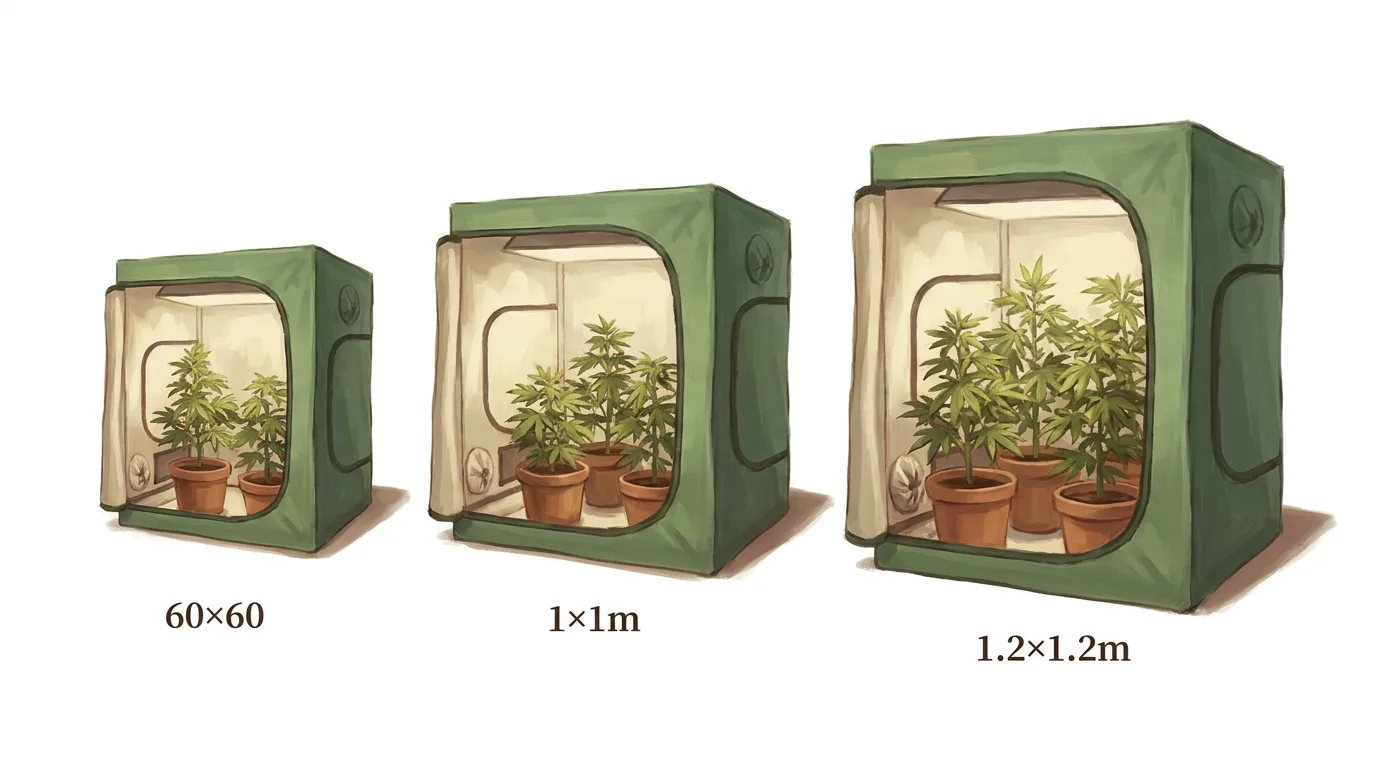
Do the maths the box won’t. Tent volume (length × width × height in metres) × 60 gives one air change a minute as your bare minimum. Then add 20–30% for the carbon filter (pulling air through carbon costs airflow) and account for ducting losses (a straight run costs 5–10%, each 90° bend 10–15%). Worked example: a 1.2 × 1.2 × 2m tent is 2.88m³ × 60 ≈ 173m³/h minimum, → ~220–250m³/h with the filter, and you’d spec a fan rated around 250m³/h so it still delivers after the bends take their cut — a 150mm (6-inch) inline fan handles it. An 80x80cm tent is grand on a 100mm (4-inch) fan. Don’t over-spec a 250mm fan onto a tiny tent — it just makes noise and folds the walls inward.
Where does the exhaust go, and how do I keep negative pressure?
Out of the room entirely — a window or wall vent. Exhausting into the same room recirculates warm, humid, CO2-depleted air straight back through the intake, so the tent gets hotter and damper every cycle. Keep ducting short and straight, gentle curves not sharp angles, and use insulated ducting on cold runs to stop condensation and dampen noise. Check the walls: gently concave means good negative pressure and contained smell; ballooning out means intake is beating extraction; slack and neutral means the fan’s too weak or the ducting too restrictive (check for kinks and a clogged filter). And remember the smell peaks in the final two weeks — that’s exactly when a saturated filter or loose duct joint will betray you, so check the system regularly rather than the once you skip being the once it matters.
Common questions
What size extraction fan do I need?
Tent volume in m³ × 60 for the minimum, then add 20–30% for the carbon filter and more for ducting bends. Roughly, a 100mm fan suits an 80x80cm tent and a 150mm fan a 120x120cm.
Why is my tent smelling even with a carbon filter?
Usually an undersized or weak fan that can't pull air through the filter fast enough to achieve negative pressure, or a saturated filter. Check wall suction and the filter's age.
Can I just open a window instead of an extraction fan?
No. An open window is uncontrolled — you can't manage humidity, temperature or smell, and odour goes everywhere. A properly sized extraction fan with passive intake gives you control.