Grow Tent Airflow and Layout: Getting It Right
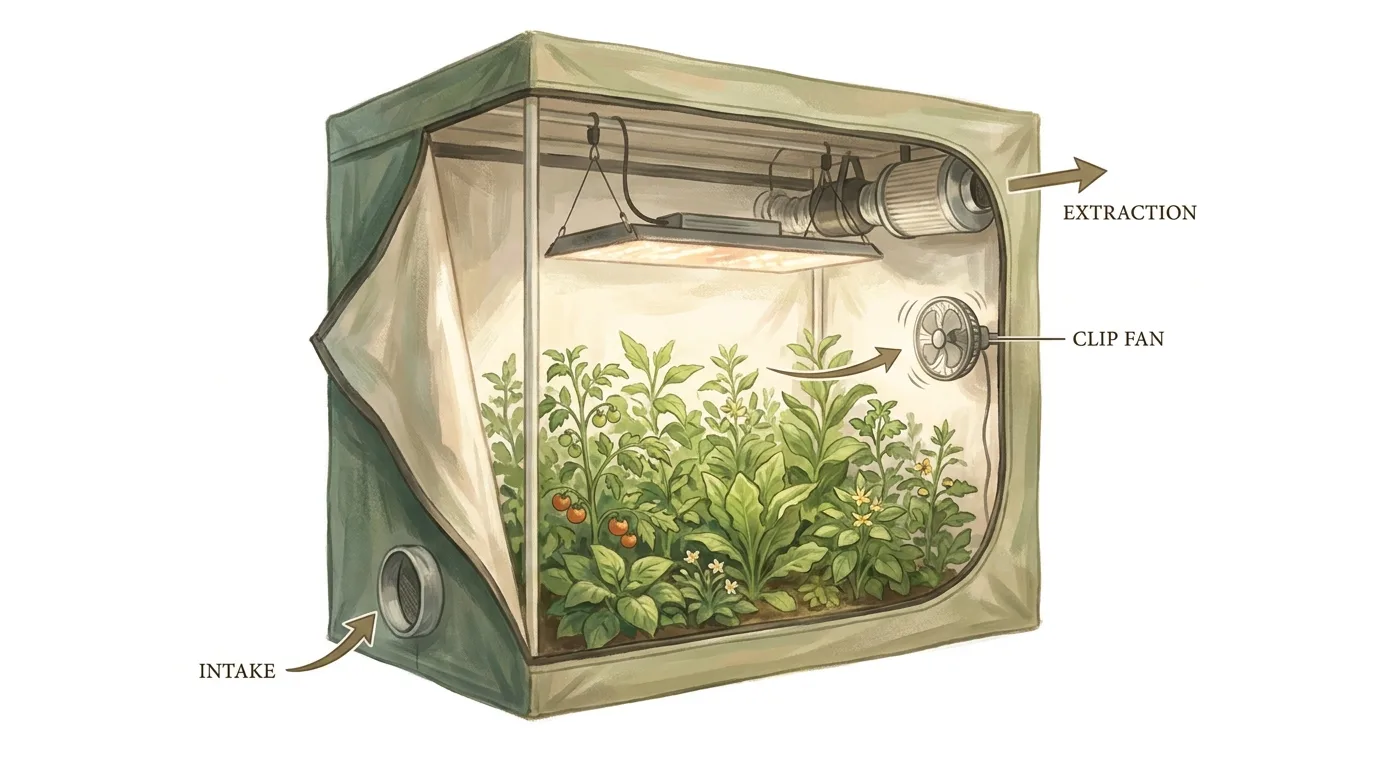
A grow tent needs three air jobs: extraction (inline fan plus carbon filter at the top, pulling air out), intake (passive vents at the bottom letting fresh air fall in), and circulation (clip fans stirring air across the canopy). Warm air exits high, cool air enters low — work with gravity, and keep negative pressure so the walls sit slightly concave and smell can’t leak out the seams. Every 90° bend in the ducting costs 10–15% of airflow, so keep it short and straight.
Airflow is where most beginners quietly lose control of temperature, humidity and mould — usually by confusing the two kinds of air movement a tent needs. Get the layout right and the environment more or less runs itself. Here’s how the air should flow and where each fan goes.
The short version:
- Extraction removes air: inline fan + carbon filter at the top, pulling air out
- Intake replaces it: passive vents at the bottom let fresh air fall in
- Circulation stirs it: clip fans move air across the canopy (they don’t remove air)
- Negative pressure (walls sucking in) keeps smell and stale air controlled
- Warm air exits high, cool air enters low — work with gravity
Want the full breakdown? Keep scrolling.
What’s the difference between extraction and circulation?
This trips everyone up. Extraction is the inline fan pulling air out of the tent through the carbon filter at the top — it removes heat, humidity and smell, and it creates the negative pressure that stops odour leaking out the seams. Circulation is the small clip fans that stir the air inside the tent without removing any — they don’t ventilate, they move air across the plants. You need both: extraction to exchange the air, circulation to keep it from going stagnant. A grower who only runs an extraction fan gets still pockets around the leaves; one who only runs clip fans gets a hot, humid tent because nothing’s being exchanged. Layer them.
How should the air actually flow?
With gravity. Warm, used air rises, so it exits high through the filter and fan; fresh, cool air enters low through the passive intake vents, pulled in by the negative pressure. So the filter and extraction go at the top, the intake vents stay open at the bottom, and the whole tent gently inhales — walls slightly concave. If the walls balloon outward, your intake is outpacing extraction (positive pressure, smell escaping); if they’re slack and neutral, the fan’s too weak or the ducting too restrictive. Keep ducting short and straight — every 90° bend costs 10–15% of your airflow — and the filter at the top where the warm, smelly air collects.
How do I set up circulation fans?
Clip fans (DIG stock them) pointed across and up through the canopy, not straight down like a hairdryer. The leaves should rustle, not flap — the tissue test is the guide: hold a tissue near the plant and the airflow should barely move it. Moving air does three real jobs: it thickens stems by gentle wind stress (still air makes weak, celery-like stems), it breaks up the stagnant humid pockets where mould starts, and it refreshes the thin boundary layer of depleted air at the leaf surface so the plant keeps feeding on CO2. One fan below the canopy and one above beats a single strong one from one side. If leaves are visibly flapping or the plant leans away, the fan’s too close — back it off.
Common questions
Do I need both an extraction fan and a circulation fan?
Yes. Extraction exchanges the tent's air (heat, humidity, smell); circulation stirs the air inside to prevent stagnant pockets and strengthen stems. They do different jobs and you need both.
Where should the intake go in a grow tent?
Low down, through the passive mesh vents, so cool fresh air is pulled in by the extraction's negative pressure and rises through the canopy. Keep the vents unblocked.
Why are my plant's stems weak and floppy?
Usually too little air movement. Still air lets the plant skimp on stem strength; a gentle clip fan making the leaves rustle triggers it to build thicker, stronger stems.